Contents
In this article, we will look at:
- What is Follicular Unit Extraction (FUE)?
- Eligibility for FUE
- The FUE procedure
- Risks and disadvantages of FUE procedure
- Advantages of FUE procedure
- Pre-treatment guidelines
- Post-treatment guidelines
- Recovery from FUE procedure
- How many grafts can be transplanted in one session?
- Cost of FUE procedure
- Alternatives to FUE procedure
- Results of FUE procedure
- More Hair-Related Procedures
You can click on any of the links above to navigate to the section of your interest.
Follicular Unit Extraction (FUE) Overview
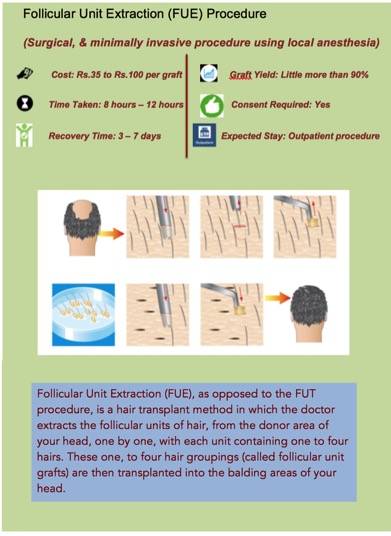
Follicular Unit Extraction (FUE), as opposed to the FUT procedure, is a hair transplant method in which the doctor extracts the follicular units of hair, from the donor area of your head, one by one.
The doctor uses a small microneedle, which punches a tiny incision around a hair follicle before extraction.
Each unit contains one to four hairs. These one to four hair groupings (called follicular unit grafts) are then transplanted into the balding areas of your head. In this method thus, there is no need for the surgeon to make a long incision in the donor area, as in the FUT procedure.
This is an ideal method of surgery for patients who like to wear their hair short. This method is also recommended for patients who have a tight scalp or have previously undergone the ‘strip’ or FUT method but with little or no success.
Am I eligible/ineligible for the FUE hair procedure?
Find out whether you are eligible/ ineligible for the FUE hair procedure from the table below:
Eligible for FUE | Ineligible for FUE |
| - If you have been diagnosed with a condition which prevents natural hair growth. - If you are above 25 years of age and have been balding for many years, and now your rashes on the scalp hair loss has stabilized. - If you find medically proven hair loss treatments do not work for you. - If you have a stable supply of donor hair. - If you find medically proven hair loss treatments do not work for you. - If you have lost hair due to traumas such as burns or cosmetic procedures such as facelift. - If you are at risk for thickened donor scars due to excessive scalp tightness or laxity. - If you have general good health. - If you would like to sport short hairstyles their own hair. - If you do not have a problem to shave your head. (The donor area needs to be shaved for an FUE procedure.) | - If the cause of your hairfall is undiagnosed and you do not have alopecia but suffer from itching. - If you are below 25 years with ongoing hair fall. - If you suffer from multiple medical conditions such as uncontrolled diabetes, hypertension, asthma, or heart problems. - If you take medicines such as blood thinners or beta blockers. - If you suffer from trichotillomania which causes people to compulsively pull out in which case you need psychiatric counseling. - If you have low density of hair on the back of the head which will not yield enough follicles for a transplant. - If you have large bald patches. |
What happens during the FUE procedure?

The follicular unit extraction method involves the following procedure:
- At the outset, the doctor anesthetizes the scalp.
- Using a small microneedle, the doctor makes a circular incision, less than 1 mm in diameter, around a follicular unit on your head, to isolate a graft.
- Then, using a tweezer-like instrument, the doctor extracts the follicular unit from your donor area. Multiple follicular units are extracted this way.
- Before the process of harvesting the follicular units, tiny holes are drilled on your scalp, where hair loss has occurred.
- The follicular units are then placed in these holes, from where they gradually start yielding hair.
- A disinfectant is gently applied to your head after the procedure.
At the end of the procedure, the doctor will ask you to wear a bandana or a cap to protect your head for a few days.
An advantage of the FUE procedure is that it has more donor site options, as grafts can be extracted from other parts of your body as well. FUE can also be used to fill in areas of eyebrows in men and women and beard in men.
What are the risks and disadvantages of the FUE procedure?
The risks and disadvantages of the FUE procedure include:
- Hundreds of tiny round white scars on the head caused by the incisions to extract the hair follicles, which will be typically invisible to the human eye after your hair has grown out.
- Numbness, bleeding, itching, swelling around the eyes and forehead, and temporary cyst formation on the areas where the hair is being transplanted.
- Risk of infection and inflammation, if proper care is not taken during and after the surgery.
- Experiencing shock hair loss, which is temporary and the hair usually grows back in 3-6 months.
- Costly, tedious and a time-consuming procedure as individual follicular units are extracted.
- Not be suitable for large areas of baldness.
- A hair loss treatment programme is required for maintenance, post the operation.
What are the advantages of an FUE procedure?
Some of the advantages of the FUE procedure include:
- It is a less invasive surgery than FUT with no visible scarring in the donor area
- It is ideal for short sessions and for patients in early stages of hair loss
- It is ideal for patients who would like to sport short hairstyles
- It is ideal for patients who have no problem in shaving their heads
- It is ideal for mustache or eyebrow replacement
What guidelines should I follow before undergoing an FUE procedure?
Once you are deemed physically fit to undergo an FUE hair procedure, there are certain guidelines you need to follow:
- If you are taking any blood thinners, please let the doctor know immediately, as they may represent a contraindication to surgery.
- If you are taking broad beta-blockers let your doctor know immediately.
- If you use inhalers, you need to bring your inhaler to the clinic on the day of the procedure.
- Your scalp should not be sunburned prior to the procedure.
- Do not take any anti-inflammatory medications (NSAIDs) for one week prior to your procedure.
- Do not take any B or E vitamins for one week before your procedure, this includes any multivitamins, as these tablets are known to increase bleeding.
- Medications prescribed to you such as heart and blood pressure medication should be taken as prescribed right up to and including the day of your procedure.
- If you smoke and drink alcohol, stop smoking and drinking alcohol two weeks prior to the procedure, as smoking and drinking can interfere with the healing process.
- If you dye your hair, please dye your hair three days prior to the procedure and be sure to scrub your scalp everyday, including on the day of the procedure, to keep it free from dye. (You need to confirm with your doctor about washing your hair on the day of the procedure)
- Some doctors may ask you to eat breakfast and lunch prior to the procedure, while others may ask you to refrain from eating and drinking at least 12 hours prior to the procedure. Please follow your doctor’s instructions.
- Some doctors may advise you to wash your hair thoroughly on the day of the procedure, while some do not. Please follow the instructions of your doctor.
- Do not apply any hair sprays or other hair styling products on the day of the surgery.
- Do not drink any caffeinated beverages on the day of the procedure.
Are there any post-treatment guidelines after the FUE procedure?
After undergoing the FUE procedure:
- Sleep in a semi-sitting position after the hair restoration procedure. This will help the swelling to reduce faster and prevent you from accidentally touching the areas where the hair follicles have been transplanted.
- Avoid touching, scratching, and rubbing the area where the hair follicles have been transplanted.
- Some doctors advise you to gently shampoo your head the very next day of the surgery. Some doctors do not. Follow your doctor’s instructions. You may also be advised to shampoo your hair twice a day after around 7 days of the surgery.
- Take the medications prescribed for you by your doctor.
- Avoid smoking and drinking alcohol for two weeks after the surgery.
- Cover your head with hats or a bandana to avoid direct contact with UV rays.
- Avoid any form of strenuous activity, including strenuous exercises for at least 28 - 30 days after an FUE procedure. You can resume mild exercises after around 14 days of the procedure.
How many grafts can be transplanted in one session of FUE and in how much time?
It will roughly take up 8-12 hours of your time, within which approximately 2000 grafts will be transplanted. You may require more sittings, which impacts the price, and can be a disadvantage.
How long does it take to recover from an FUE procedure?
It takes approximately 3 to 7 days to recover from an FUE procedure.
What is the cost per graft in an FUE procedure?
Cost of FUE Hair Transplant can vary depending upon the city/locality, clinic/hospital type & amenities, experience of the provider, the technology & material used, extent of baldness, and donor area etc.
The cost may range from is Rs. 35 to Rs. 120 per graft
(Price is higher per graft than in an FUT procedure as FUE procedure is time-consuming)
Please consult your doctor to get the exact treatment plan and price quote suiting your unique needs.
Are the results of FUE procedure permanent?
Hair transplant results are generally considered to be permanent.
Are there any alternatives to FUE procedure?
Based on the pattern and amount of your hair loss, skin condition, and size of the bald patches on your head, an alternative to FUE hair procedure may be FUT.
More Hair Treatment-Related Topics
People interested in this topic also read:
- Hair Fall Treatment Procedures
- Hair Transplantation Procedures Overview
- Follicular Unit Transplantation (FUT)
- Follicular Unit Extraction (FUE)
- Scalp Reduction Surgery
- Artificial/Synthetic Hair Implant
- Platelet-Rich Plasma (PRP) Therapy for Hair Growth
References
1. Bicknell L, Kash N, Kavouspour C, Rashid R. Follicular unit extraction hair transplant harvest: a review of current recommendations and future considerations [Internet]. Escholarship.org. 2018 [cited 21 February 2018]. Available from: https://escholarship.org/uc/item/1954f4vv
2. Loganathan E, Narasimhan R, Sarvajnamurthy S, Siddaraju M, Suresh D, Gorur D. Complications of hair restoration surgery: A retrospective analysis [Internet]. 2018 [cited 21 February 2018]. Available from: https://www.ncbi.nlm.nih.gov/pmc/articles/PMC4212293/
3. Bernstein R. Pre-making recipient sites to increase graft survival in manual and robotic FUE procedures [Internet]. 2018 [cited 21 February 2018]. Available from: https://www.researchgate.net/profile/Robert_Bernstein2/publication/267450939_Pre-Making_Recipient_Sites_in_FUE_and_R-FUE_Procedures/links/5452a0920cf2cf51647a47ae.pdf
4. Avram M, Rogers N, Watkins S. Side-effects from follicular unit extraction in hair transplantation [Internet]. 2018 [cited 21 February 2018]. Available from: https://www.ncbi.nlm.nih.gov/pmc/articles/PMC4271303/
5. Szipocs R. Fiberscope-An optical fiber laser based, Handheld 3D nonliner microscope system for invivo diagnostic applications in Dermatology and Nanomedicine [Internet]. 2018 [cited 21 February 2018]. Available from: https://www.omicsonline.org/proceedings/fuehair-transplantation-vs-combo-method-40083.html
Patient Experiences


Questions answered by trusted doctors




Did you know?
Everyday hair fall
Do you ever see a lot of hair in the drain after showering? That’s normal–we shed between 40 and 150 strands of hair a day.
Hair chemistry
The hair on our heads is composed of: 50 percent carbon, 21 percent oxygen, 17 percent nitrogen, 6 percent hydrogen, and 5 percent sulphur.
It is normal to lose a few hairs everyday
How much hair do we have on our scalp? More than you think. The average person has 100,000 - 150,000 strands of hair on her head (so don’t worry too much if you lost 40 - 150 hairs today while showering).
Related videos



Related articles
The treatment method of using various treatments like chemotherapy, radiation, anti-cancer drugs to either cure, treat, control, or reduce the symptoms of any types of cancer can be grouped together as cancer treatments.
Rhinoplasty is known as nose job. It is a plastic surgery which helps in reconstructing and correcting the shape of the nose. Reconstructive surgery and Cosmetic surgery are the two types. Nose job helps in improving the appearance of the nose.
A highly-advanced technique of hair transplantation, Follicular Unit Transplantation (FUT) is performed in a way, which imitates the pattern of natural hair growth and is an ideal choice for people who have large bald areas on their head.